Now is the time to scale SAF in the UK
By Sophia Haywood, Director, EU and UK Government Affairs, Policy and Sustainability, LanzaJet.
As the aviation industry grapples with the urgent need to reduce carbon emissions, Sophia Haywood, Director of EU and UK Government Affairs, Policy and Sustainability at LanzaJet, calls for continued cross-party support on Sustainable Aviation Fuel (SAF) and urges policy makers to not lose momentum at this critical juncture.
Across the UK, there has been strong bipartisan consensus that sustainable aviation fuel (SAF) is a critical solution for decarbonising flights. While hydrogen and electric flight could provide a solution for short-haul flights in the long term, SAF will be critical for reducing emissions today, tomorrow and well into the future.
Unlike conventional jet fuel, SAF has the potential to significantly reduce lifecycle greenhouse gas emissions, offering a sustainable alternative that integrates seamlessly with existing aircraft and fuelling infrastructure. It can be made from a variety of sustainable feedstock, from agricultural and forestry residues, household waste and sustainably grown crops.
The UK has set ambitious but achievable mandates for increasing the proportion of SAF in the market, increasing from 2 per cent in 2025, 10 per cent by 2030 and to 22 per cent by 2040. In addition to these figures, the UK has sensibly included a cap on HEFA (SAF made from oils and fats) due to global limitations, to encourage investment in other routes to SAF production, such as ethanol-to-jet.
Crucially, the UK SAF Mandate has received support across political lines. Originally introduced by the Conservative government and now carried forward by the current Labour government, the policy highlights that – regardless of political affiliation – SAF makes sense.
This cross-party endorsement has sent strong market signals to the SAF industry, and LanzaJet has heard their call.
LanzaJet: bringing ethanol-to-jet technology to the UK
Established in 2020, after a decade of technology development, LanzaJet is relentlessly committed to accelerating a net-zero transition for aviation. Named a TIME100 Most Influential Company for 2024, LanzaJet is backed by investors across the value chain, including British Airways, Airbus, Shell and Microsoft, and has been supported by the UK government through the Green Fuels, Green Skies competition and the Advanced Fuels Fund.
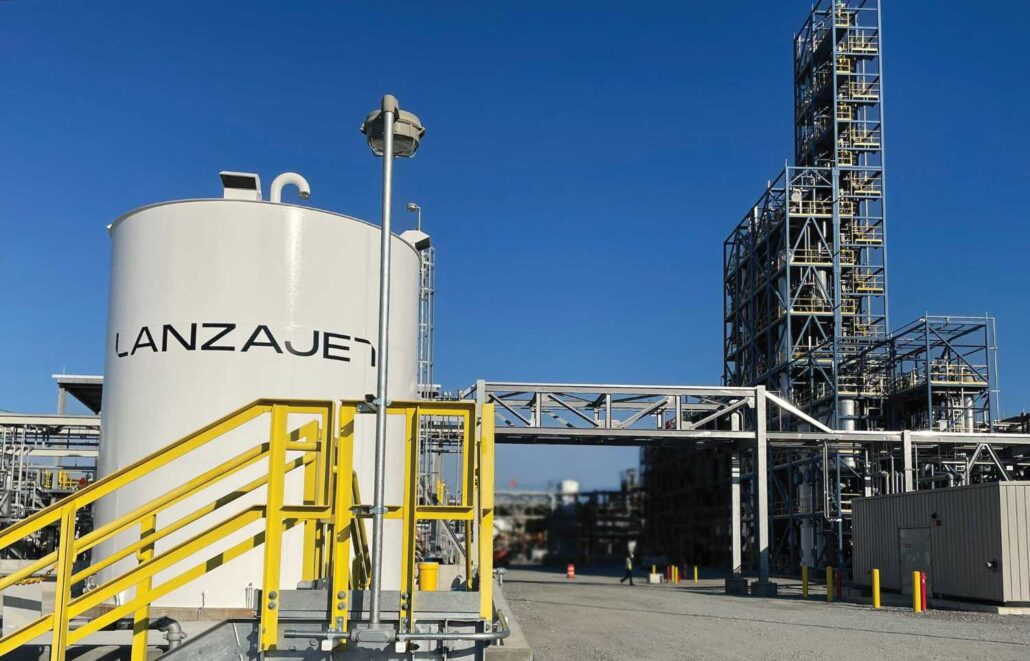
In 2024, LanzaJet constructed the world’s first ethanol-to-SAF plant in Soperton, Georgia, in the US, with a capacity of 30,000 tonnes of SAF. This created 125 direct jobs over the construction phase, as well as 31 direct and 25-50 indirect jobs during ongoing operations.
Following this success, the company is now turning its attention to scaling the technology globally. Projects are currently being developed on five continents and in over 25 countries including the US, Australia, Japan and India, as well as in Europe, with the UK as its first commercial flagship project outside the US.
Project Speedbird: LanzaJet and British Airways join forces in Teesside
Project Speedbird is a 90,000-tonne ethanol-to-SAF facility developed jointly between LanzaJet and British Airways, located at Wilton International in Teesside. The facility will produce SAF from sustainably sourced ethanol and is expected to reduce the net carbon dioxide emissions by approximately 230,000 tonnes per year – equivalent to 26,000 British Airways UK domestic flights.
Project Speedbird is forging key collaborations across the region to further bolster the local economy. Its interconnectivity with other local net-zero industries, such as hydrogen, renewable electricity, storage and pipelines, and steam generation, positions Speedbird as a critical enabler of the broader energy transition across the region. As many sectors must decarbonise in tandem, partnership across industry and government is essential.
The facility is expected to generate around 30 well-paid, highly skilled, long-term operational roles, alongside hundreds during construction. Importantly, the project could play a transformational role in an area that ranked among the 10 per cent most deprived in the UK in 2019, facing a 39.3 per cent child poverty rate, persistent unemployment and low average wages.
As the project makes its way through project development milestones, it hopes to reach a final investment decision in 2026 and then complete construction in 2028. Only three years away, maintaining the momentum on SAF and making it as seamless as possible to scale SAF in the interim is key.
A missed opportunity: British bioethanol
One key opportunity for the UK lies in enabling the use of British-produced bioethanol. Under the current rules of the UK SAF Mandate, this feedstock is excluded from eligibility – despite its existing use in the road transport sector.
The UK bioethanol industry, already under pressure, recently warned that the UK-US trade deal could push the sector toward collapse. This is a high-value industry, with 895 million litres¹of renewable fuel production capacity, thousands of jobs, strong links to British agriculture, and the production of critical co-products such as CO₂ for the NHS.
Allowing the use of sustainable first-generation bioethanol for SAF production would establish a long-term market for domestic producers while supporting agricultural and aviation sectors. Estimates suggest this could result in over 300,000 tonnes of SAF²– nearly enough to meet the UK’s non-HEFA SAF mandate requirement for 2030.
Keep up the momentum
SAF policy was born out of cross-party consensus, and we should not lose sight of this. The entirety of the UK, now more than ever, wants to see a thriving future for the generations that follow us, and SAF underpins this. From job creation and scaling supply chains, reducing emissions and improving air quality, to enabling economic growth across the entirety of the UK, SAF and the transition to net-zero is a game-changer for growth, not a threat.
The LanzaJet slogan is “Someday is Now.” It’s three words that serve as a reminder that the once far-off dream of emission-free aviation is no longer a dream. We have the solutions and the capacity to act now to create a cleaner future. I hope it inspires readers, across differing political lines, to see that day is really not that far away.
References
1. DEFRA; Bioenergy Crops in England and the UK: 2008-2023. (June 2024)
2. Assuming RSB’s 69% conversion rate
This article was originally published in The Path To Net Zero supplement circulated alongside The House magazine. To find out more visit The Path To Net Zero hub
